


Cinematic Emotion Lab
AI systems for cinematic emotion, film music analysis, and computational storytelling.
This repository documents an active, ongoing research program. Findings are released in stages. The full dataset, trained models, and theoretical conclusions will be disclosed through publication channels.
What This Research Explores
Film music is a precision emotional engineering system. A composer writing for picture does not approximate emotion – they construct it, at specific timecodes, against specific visual events. This research asks: can that construction be computationally modeled?
The lab investigates five interconnected questions:
Research Components
| Component | Domain | Status |
|---|---|---|
|
Acoustic Feature Extraction |
Music Information Retrieval |
Active · EXP-001 |
|
Emotion Annotation Framework |
Human-in-the-Loop AI |
In Development |
|
Cinematic Dataset Construction |
Data Engineering |
Ongoing |
|
Harmonic Tension Modeling |
Computational Musicology |
Experimental |
|
Narrative Emotion Arc Mapping |
Computational Storytelling |
Theoretical |
|
Composer Interpretation System |
Human Annotation |
In Progress |
|
ML Emotion Classifier |
Supervised Learning |
Baseline Stage |
|
Spectral Suspense Detection |
Audio Signal Processing |
Experimental |
System Architecture
The system architecture is designed around a single principle: each layer must be independently interrogable. The pipeline operates across four abstraction layers:
Layer 1 - Signal
Raw audio ingestion, format normalization, mono conversion, sample rate standardization. All clips processed to 22050Hz, float32.
Layer 2 - Features
Multi-domain acoustic feature extraction. 71 dimensions per clip across 7 feature groups. Designed to be over-complete at this stage; dimensionality reduction applied downstream.
Layer 3 - Annotation
Composer-led emotional labeling integrated as supervised targets. Schema captures primary/secondary emotion, intensity (1–5), narrative position, harmonic mode, and orchestration density.
Layer 4 - Modeling
Classical ML baselines → deep sequence models → transformer architectures. Each model evaluated against composer annotations as ground truth.
Emotion Mapping Framework
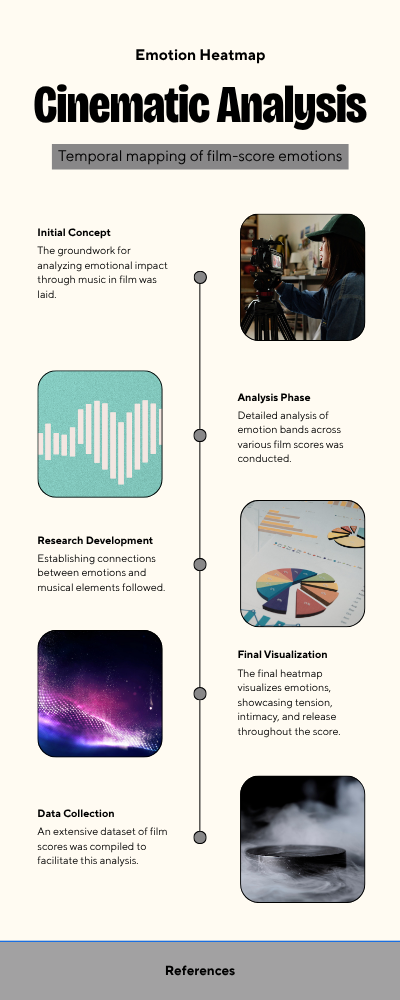
The emotion mapping framework treats cinematic emotion as a structured, multi-dimensional space. Each audio clip is annotated along five axes:
- Primary emotion – tension · triumph · grief · suspense · joy · dread · longing · ambiguity
- Emotional intensity – 1 (minimal) to 5 (maximal)
- Narrative position – opening · rising · climax · falling · resolution
- Harmonic mode – major · minor · modal · atonal
- Orchestration density – 1 (sparse) to 5 (dense)
Annotations are provided by the primary researcher in the role of film composer – capturing compositional intent, not audience perception. This distinction is methodologically deliberate and fully documented in docs/methodology-preview.md.
The temporal heatmap surfaces how emotional content evolves through a cue – a dimension that static clip-level analysis cannot reveal.
Signal Analysis Layer
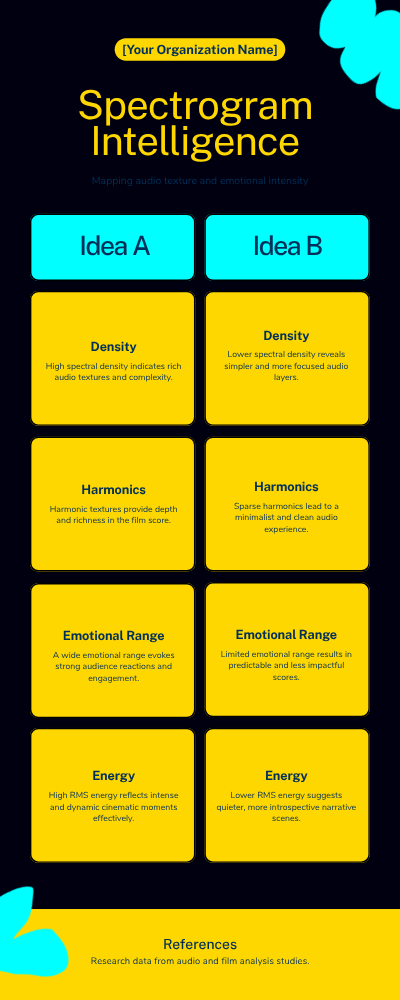
The signal analysis layer extracts a 71-dimensional acoustic feature vector per clip across seven domains:
| Feature Group | Dimensions | Emotional Relevance |
|---|---|---|
| MFCCs (13 coefficients × mean+std) | 26 | Timbral identity · instrumental texture |
| Chroma CQT (12 pitch classes × mean+std) | 27 | Key · mode · harmonic color |
| Spectral (centroid · bandwidth · rolloff) | 6 | Brightness · tension · spectral weight |
| RMS Energy (mean · std · max · dynamic range) | 4 | Loudness · dynamic shape · dramatic weight |
| Zero Crossing Rate | 2 | Noisiness · percussive density |
| Tempo | 1 | Pacing · urgency |
| Harmonic / Percussive Ratio | 3 | Orchestral texture · structural balance |
| Total | 71 |
Full extraction pipeline available in notebooks/experiments/NB-EXP-001.
Composer vs. AI Interpretation
“The machine hears amplitude, frequency, and time. The composer hears grief.”
- Research axiom, Cinematic Emotion Lab
One of the most consequential threads in this research is the Composer Gap – the structured, measurable divergence between what an acoustic model predicts and what a film composer says they constructed.
Early annotation work has begun to surface the shape of this gap. Working hypotheses under active investigation:
- The model collapses emotional ambiguity onto high-confidence categorical neighbors
- Dynamic intensity is conflated with emotional weight
- Cues built around negative space – deliberate silence, withheld resolution – are systematically underscored
- The model performs well when tempo and mode co-occur in expected directions, and fails when composers deliberately disrupt that expectation
Quantitative results are embargoed pending publication.
Theoretical framing: docs/composer-ai-interpretation.md
What Is Public Now
Asset Description NB-EXP-001 Full feature extraction pipeline notebook – 71-feature matrix, cinematic visualizations docs/methodology-preview.md Research methodology overview – signal analysis through interpretive study docs/research-components.md Component inventory with status and domain mapping docs/composer-ai-interpretation.md Composer Gap study design and theoretical framing research-logs/001-research-positioning.md Research positioning and foundational framing research-logs/002-emotion-mapping-framework.md Emotion mapping framework design notes Visual identity system Hero banner · pipeline diagram · emotion heatmap · research architecture
What Will Be Released Later
| Release | Content | Timeline |
|---|---|---|
| v0.2 | Anonymized sample feature matrix · annotation schema · EDA notebooks | Q3 2026 |
| v0.3 | Baseline classification results (qualitative) · UMAP feature space visualization | Q4 2026 |
| v0.4 | Full interactive visualization suite · harmonic tension arc analysis | Q4 2026 |
| v0.5 | Sequence model architecture · EXP-003 design notebook | Q1 2027 |
| v1.0 | Complete dataset · trained models · paper preprint | 2027 |
Full schedule: docs/UPCOMING_RELEASES.md
How to Follow the Research
Watch this repository – releases are staged and announced through commits.
Read in this order:
- docs/RESEARCH_PHILOSOPHY.md – what this research believes and why
- docs/RESEARCH_QUESTIONS.md – what is being tested
- docs/methodology-preview.md – how it is being tested
- notebooks/experiments/NB-EXP-001 – the first experiment
- docs/composer-ai-interpretation.md – the central theoretical problem
Research logs are committed regularly to research-logs/ – field notes from an active research practice.
Inquiries and collaboration – open a GitHub Issue labeled inquiry.
Author
Bernard G. Film Composer · AI Architect · Computational Musicology Researcher
Professional background spanning film scoring, software engineering, data science, and architectural design – brought to bear on a single research problem: what does cinematic music do to the human mind, and can that be computed?
Research Preview Notice
his repository documents an active, publication-track research program operating under a staged public disclosure framework. The following notices govern how this repository and its contents should be understood and used.
This is not a final publication. The research is substantially complete at the experimental level. Findings, trained models, and the full annotated corpus are withheld pending peer-reviewed publication. What is public is methodology, infrastructure, partial data, and qualitative framing – not conclusions.
Results are embargoed. Quantitative results from EXP-002, EXP-003, and EXP-004 are withheld pending peer review. Qualitative characterizations of results are released on the schedule documented in ROADMAP.md. Do not represent embargoed findings as publicly known.
Staged release schedule. Each public release surfaces one deliberate layer of the research. The release sequence, rationale, and forthcoming milestones are documented in ROADMAP.md and STAGED_RELEASE_STRATEGY.md.
Citation Notice
If you use this repository – its methodology, feature extraction pipeline, annotation schema, public corpus subset, or any written research documentation – in academic or professional work, please cite it.
A machine-readable citation is available in CITATION.cff. Formatted citations (APA, BibTeX, MLA, Chicago) are provided in docs/citation-and-use-policy.md.
Short-form attribution:
Cinematic Emotion Lab – Bernard G. (2026) · https://github.com/bernardvgosh/cinematic-emotion-lab
OSF project: https://osf.io/wa2q8 OSF registration DOI: https://doi.org/10.17605/OSF.IO/EU89S
When the formal publication associated with this research is released, please update your citation to reference the peer-reviewed paper. A repository notice will be committed at that time.
Intellectual Property and Disclosure Notice
This research program is pending intellectual property review. The research methodology, compositional intent annotation framework, and the Composer Gap study design documented here represent original contributions by the author. No patent applications are claimed as of the current release.
The cinematic audio cues forming the research corpus are original compositions and are not licensed for use outside this research program without explicit written permission.
For the complete IP and data policy: docs/ip-and-disclosure-notice.md For citation and acceptable use terms: docs/citation-and-use-policy.md
License & Data Policy
Code: MIT License · LICENSE
Research documentation, schemas, and visual assets: CC BY-NC 4.0 · LICENSE
Data: Audio files are not committed to this repository. The public acoustic feature subset is available at datasets/processed. Full annotated dataset releases with v1.0, timed to publication. See docs/ip-and-disclosure-notice.md for complete data policy.
Findings: Quantitative results from EXP-002, EXP-003, and EXP-004 are embargoed pending peer review.
Cinematic Emotion Lab · Where film composition meets machine intelligence.
Get in touch
Bernard Consulting
Want to work with Bernard on your digital projects? Send him a message to let him know what your challenges are! You can reach out to Bernard via his Linkedin profile. https://www.linkedin.com/in/bernard-g/
Email
bernard@vgoshinfo.com
Phone:
+1 (954)-804-4785
Address:
Vgosh Info LLC, 111 NE, 1st Street,
8th Floor, 88510, Miami, FL 33142
8th Floor, 88510, Miami, FL 33142